AI Observability: Monitoring AI Systems Effectively for Better Business Performance
AI Observability: Monitoring AI Systems Effectively for Better Business Performance


What Is AI Observability?

Introduction: Your AI Worked Perfectly Yesterday… So Why Is It Failing Today?


Your company decides to implement an AI customer service bot. In the first month, it works brilliantly. Customers receive instant responses, the number of support tickets falls, and your employees become more efficient.

After some time however, the number of customer complaints rises.

Your bot’s replies have become obsolete. Recommendations appear inaccurate. Some customers even receive downright false information. Nothing seems to be wrong with the software, and the AI does not perform as well as before.

What could be the cause of this?


This is a frequent problem most companies face once Artificial Intelligence is rolled out. AI model creation is only the starting point. As soon as the model starts to operate in the real world, its performance will evolve – changes in customer behavior, data variations, adjustments in business priorities, and constant external factors always influence outcomes.

If no constant vigilance is applied, the company may not discover there’s an issue until the customers have already been impacted. AI Observability, for these reasons, has become a vital component of modern AI operations. With it, companies can gauge the behavior of AI systems in production by continuously monitoring data quality, model behavior, predictions, system status and business effects.

It is much more than verifying that an AI system is online; AI Observability provides solutions to complex questions like: – Is the AI making reliable decisions? – Have the input data parameters changed? – Will predictions begin to become inaccurate? – Does the model contain bias? – Will the AI contribute to measurable business objectives?

From my experience, winning AI projects are determined not by how quickly they are introduced, but by how effectively they are monitored after their deployment. Businesses that continuously observe and improve their AI systems achieve optimal long-term results. In this manual, we’ll provide an in-depth look at the fundamentals of AI Observability, its relevance, its divergence from classic monitoring methods, and the approach companies can adopt to build stable, clear, and high-quality AI systems.


1. What Is AI Observability?


AI Observability is the practice of continuously monitoring, analyzing, and improving AI systems after they have been deployed into production.


Unlike traditional software monitoring, AI observability focuses on understanding:


  • Model performance

  • Prediction accuracy

  • Data quality

  • System behavior

  • Business impact

  • Model reliability


Its goal is not only to detect failures but also to explain why those failures occur.


Think of AI as an employee.


Hiring the employee isn't enough.


You also evaluate their performance, provide feedback, measure productivity, and help them improve over time.


AI systems require the same ongoing attention.


2. Why AI Observability Matters


Many organizations invest heavily in building AI models but overlook what happens after deployment.


Without observability, businesses may continue relying on AI systems that gradually become less effective.


1. Detect Performance Issues Early


Continuous monitoring helps identify problems before customers experience them.


Examples include:


  • Declining prediction accuracy

  • Slower response times

  • Unexpected system behavior

  • Missing or incomplete data


Early detection reduces operational risks.


2. Maintain Customer Trust


Customers expect AI-powered services to provide consistent experiences.


If recommendations become inaccurate or automated responses become irrelevant, trust quickly declines.


Observability helps maintain reliability over time.


3. Improve Business Decisions


Business leaders depend on AI insights for decision-making.


Monitoring ensures those insights remain accurate as business conditions change.


4. Reduce Operational Costs


Detecting issues early prevents larger problems that require expensive fixes later.


Small adjustments made continuously are often more cost-effective than rebuilding AI models from scratch.


5. Support Regulatory Compliance


Many industries require organizations to monitor AI systems for fairness, transparency, and accountability.


AI observability supports these compliance efforts.


3. AI Observability vs Traditional System Monitoring


At first glance, AI observability may seem similar to application monitoring.


However, there are important differences.


Traditional monitoring focuses on questions like:


  • Is the server running?

  • Is the application available?

  • Are response times acceptable?

  • Are there software errors?


AI observability goes much deeper by asking:


  • Is the model still accurate?

  • Has customer behavior changed?

  • Has the training data become outdated?

  • Are predictions drifting over time?

  • Is the model introducing unexpected bias?


Traditional monitoring keeps software operational.


AI observability keeps AI intelligent.


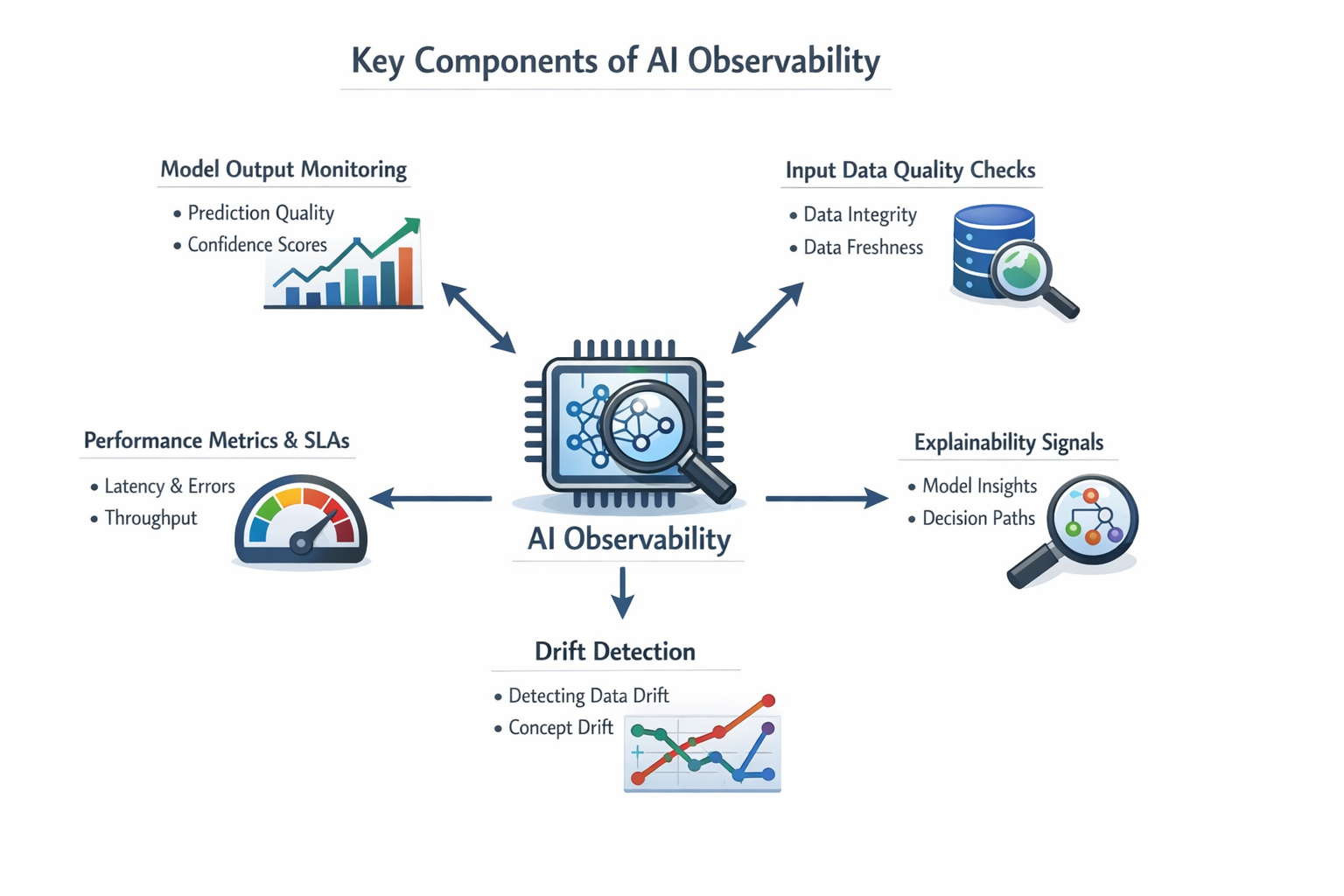
4. Key Components of AI Observability


Effective AI observability includes several important areas.


1. Data Monitoring


AI relies entirely on data.


Businesses should monitor:


  • Missing values

  • Duplicate records

  • Data consistency

  • Data freshness

  • Unexpected changes


Poor-quality data often causes declining AI performance.


2. Model Performance Monitoring


Businesses should regularly evaluate:


  • Accuracy

  • Precision

  • Recall

  • Prediction confidence

  • Error rates


Performance metrics help determine whether retraining is necessary.


3. Data Drift Detection


Customer behavior evolves.


Markets change.


Products change.


When incoming data begins differing significantly from the original training data, AI performance can decline.


This phenomenon is known as data drift.


Detecting drift early prevents inaccurate predictions.


4. Model Drift Monitoring


Sometimes the data remains stable, but the relationship between data and outcomes changes.


For example:


An AI model trained before major economic changes may produce less accurate financial predictions afterward.


Monitoring model drift ensures AI continues adapting to changing business environments.


5. Business Impact Monitoring


Observability shouldn't stop at technical metrics.


Organizations should also measure:


  • Customer satisfaction

  • Revenue impact

  • Conversion rates

  • Productivity improvements

  • Operational efficiency


Business outcomes ultimately determine AI success.


5. Real-World Applications of AI Observability


AI observability provides value across nearly every industry.


Healthcare


Hospitals monitor AI diagnostic systems to ensure prediction accuracy remains high as patient populations and medical practices evolve.


Doctors receive more reliable recommendations while maintaining patient safety.


Banking


Financial institutions monitor fraud detection models to ensure they continue identifying suspicious transactions as fraud patterns change.


Continuous monitoring reduces financial risk.


Retail


Retailers observe recommendation engines to ensure product suggestions remain relevant during seasonal changes and evolving customer preferences.


Better recommendations improve customer satisfaction and increase sales.


Manufacturing


Manufacturers monitor predictive maintenance AI models that identify equipment failures.


Observability ensures maintenance recommendations remain accurate, reducing downtime and repair costs.


Customer Support


Businesses monitor AI chatbots to evaluate:


  • Response quality

  • Customer satisfaction

  • Resolution rates

  • Escalation frequency


This helps continuously improve customer experiences.


For businesses looking to deploy reliable, scalable, and continuously monitored AI solutions, partnering with experienced professionals through AI Development Services:  can help implement intelligent systems with built-in monitoring, performance tracking, and long-term optimization.


Personal Observation: Deployment Isn't the Finish Line


One misconception I often see is the belief that once an AI model is deployed, the hard work is over. In reality, deployment is just the beginning. AI systems operate in dynamic environments where customer behavior, market trends, and business processes evolve constantly.


The organizations that see lasting success treat AI as a living system rather than a one-time project. They monitor performance, learn from real-world outcomes, and refine their models continuously. This proactive approach not only keeps AI accurate but also builds greater trust among employees, customers, and stakeholders.


6. How to Implement AI Observability Successfully


Building an AI model is only half the journey. To ensure long-term success, businesses need a structured observability strategy that keeps AI systems accurate, reliable, and aligned with business goals.


Step 1: Define Success Metrics


Before monitoring begins, decide what success actually looks like.


Technical metrics may include:


  • Prediction accuracy

  • Response time

  • Model confidence

  • Error rate


Business metrics may include:


  • Customer satisfaction

  • Revenue growth

  • Cost savings

  • Employee productivity

  • Customer retention


Measuring both technical and business outcomes provides a complete picture of AI performance.


Step 2: Monitor Data Continuously


Since AI relies on data, every change in data quality can affect results.


Regularly monitor:


  • Missing records

  • Duplicate entries

  • Invalid values

  • Data freshness

  • Unexpected patterns


Maintaining clean, consistent data keeps AI models dependable.


Step 3: Detect Drift Early


Markets evolve.


Customers change their buying habits.


New regulations emerge.


Competitors introduce new products.


All these changes influence AI performance.


Businesses should establish automated alerts whenever significant data drift or model drift is detected so corrective action can be taken quickly.


Step 4: Keep Humans Involved


Even advanced AI systems benefit from human oversight.


Business experts should periodically review:


  • AI recommendations

  • Prediction accuracy

  • Customer feedback

  • Unusual outputs


Human expertise helps identify issues that automated monitoring may overlook.


Step 5: Retrain Models When Necessary


AI models shouldn't remain unchanged forever.


Retraining becomes necessary when:


  • Accuracy declines

  • Customer behavior shifts

  • New products launch

  • Business rules change

  • Large volumes of new data become available


Continuous improvement keeps AI relevant and effective.


7. Common AI Observability Mistakes


Many organizations deploy AI successfully but struggle to maintain performance because they overlook ongoing monitoring.


1. Monitoring Only Technical Metrics


A model may achieve high accuracy while failing to deliver meaningful business value.


Always evaluate business KPIs alongside technical performance.


2. Ignoring Data Drift


One of the most common reasons AI performance declines is changing input data.


Businesses should never assume customer behavior remains constant.


3. Waiting for Customers to Report Problems


Reactive monitoring often damages customer trust.


Observability should identify issues before customers experience them.


4. Treating AI as a One-Time Project


AI requires continuous maintenance.


Successful organizations regularly review, improve, and retrain their models rather than considering deployment the final milestone.


5. Overlooking Explainability


Monitoring predictions alone isn't enough.


Businesses should also understand why AI makes specific recommendations.


Explainability and observability work together to improve trust and accountability.


8. Best Practices for Effective AI Observability


Organizations with mature AI operations typically follow these best practices.


1. Align Monitoring with Business Goals


Every monitored metric should support a measurable business objective.


Avoid tracking numbers that don't influence decision-making.


2. Create Automated Alerts


Configure alerts for:


  • Performance degradation

  • Data quality issues

  • Drift detection

  • Unexpected prediction patterns

  • System failures


Automation enables faster responses.


3. Monitor the Entire AI Lifecycle


Observability shouldn't begin after deployment.


It should cover:


  • Data collection

  • Model training

  • Validation

  • Deployment

  • Production monitoring

  • Retraining


Continuous oversight improves long-term reliability.


4. Document Changes


Maintain records of:


  • Model versions

  • Training datasets

  • Performance metrics

  • Configuration updates

  • Retraining history


Documentation simplifies troubleshooting and compliance.


5. Build Cross-Functional Collaboration


AI success depends on collaboration between:


  • Data scientists

  • Developers

  • Business leaders

  • Security teams

  • Operations teams


Monitoring becomes more effective when every department contributes insights.


9. Future Trends in AI Observability


As Artificial Intelligence continues evolving, observability platforms are becoming more intelligent and automated.


Several trends are shaping the future.


Self-Monitoring AI Systems


Future AI platforms will automatically detect performance issues and recommend corrective actions before problems affect customers.


AI-Powered Observability


Ironically, AI itself is being used to monitor other AI systems.


Advanced platforms can automatically identify anomalies, drift, and unusual prediction patterns.


Greater Regulatory Compliance


AI governance regulations increasingly require organizations to demonstrate continuous monitoring, transparency, and accountability.


Observability will become a compliance necessity.


Integrated MLOps Platforms


Modern MLOps solutions combine deployment, monitoring, retraining, explainability, and governance into unified platforms.


This simplifies AI lifecycle management.


Business-Centric Dashboards


Instead of displaying only technical metrics, future observability platforms will focus more on business outcomes such as revenue, customer experience, and operational efficiency.


10. Why AI Observability Creates Long-Term Business Value


Many organizations focus primarily on building accurate AI models.


However, sustainable AI success depends on keeping those models accurate over time.


Businesses that invest in AI observability can:


  • Improve decision-making

  • Detect issues before customers are affected

  • Increase customer trust

  • Reduce operational risks

  • Maintain regulatory compliance

  • Improve AI reliability

  • Maximize return on AI investments


In my opinion, observability is what transforms AI from an experimental technology into a dependable business asset. Without continuous monitoring, even the most advanced AI models can gradually lose their effectiveness. Organizations that actively monitor and improve their AI systems position themselves for long-term success in an increasingly data-driven world.


Conclusion


Artificial Intelligence is no longer a one-time deployment—it is an ongoing business capability that requires continuous attention. As customer expectations, business environments, and data evolve, AI systems must evolve with them.


AI Observability provides organizations with the visibility needed to monitor model performance, detect drift, maintain data quality, and ensure AI continues delivering meaningful business outcomes. Rather than waiting for problems to surface, businesses can identify potential issues early, make proactive improvements, and maintain trust with customers and stakeholders.


Organizations that prioritize observability not only improve AI accuracy but also strengthen operational resilience, regulatory compliance, and long-term return on investment. Monitoring AI effectively is no longer optional; it has become a fundamental part of responsible AI adoption.


If you're planning to integrate AI with customer-centric business processes and intelligent automation, explore CRM Software Development:  to build scalable systems that combine customer data, automation, and AI-powered insights for sustainable business growth.


The future belongs to businesses that don't just deploy AI—but continuously observe, improve, and optimize it. That's how intelligent systems become trusted business partners rather than unpredictable tools.


Frequently Asked Questions (FAQs)


1. What is AI Observability?


AI Observability is the practice of continuously monitoring AI systems after deployment to evaluate data quality, model performance, prediction accuracy, system health, and business impact.


2. Why is AI Observability important?


It helps organizations detect performance issues early, monitor data drift, improve reliability, maintain compliance, and ensure AI continues delivering accurate and valuable results.


3. How is AI Observability different from traditional monitoring?


Traditional monitoring focuses on infrastructure and application health, while AI observability evaluates AI-specific factors such as model accuracy, drift, prediction quality, and business outcomes.


4. What is data drift in AI?


Data drift occurs when new input data differs significantly from the data used to train the AI model, potentially reducing prediction accuracy.


5. What is model drift?


Model drift happens when the relationship between input data and expected outcomes changes over time, causing AI performance to decline even if the input data appears consistent.


6. Which industries benefit from AI Observability?


Healthcare, banking, retail, manufacturing, logistics, cybersecurity, insurance, and customer service organizations all benefit from continuous AI monitoring.


7. How often should AI models be monitored?


AI systems should be monitored continuously, with regular performance reviews and retraining whenever significant drift or declining accuracy is detected.


8. How does AI Observability improve business performance?


By ensuring AI systems remain accurate, reliable, and aligned with business goals, observability improves customer experiences, reduces operational risks, supports compliance, and maximizes the long-term value of AI investments.


Leave a Reply

Your email address will not be published. Required fields are marked *